Building a Secure Bootloader for STM32 Embedded Systems
Problem
Devices in the field had firmware bugs that needed fixes urgently. Current update process required customers to use external programmers (J-Link, ST-Link), connect via debug pins, and manually flash—a 45-minute, error-prone process requiring technical expertise. No way to push updates remotely, and every mistake risked bricking the device.
- Manual field updates required customer support involvement
- Risk of bricked devices if update failed mid-flash
- No ability to roll back if firmware had issues
- No firmware integrity verification (no way to ensure legitimate updates)
- Impossible to push emergency security patches
Solution: Secure Bootloader
Developed a minimal bootloader handling firmware updates, verification, and rollback protection.
Architecture
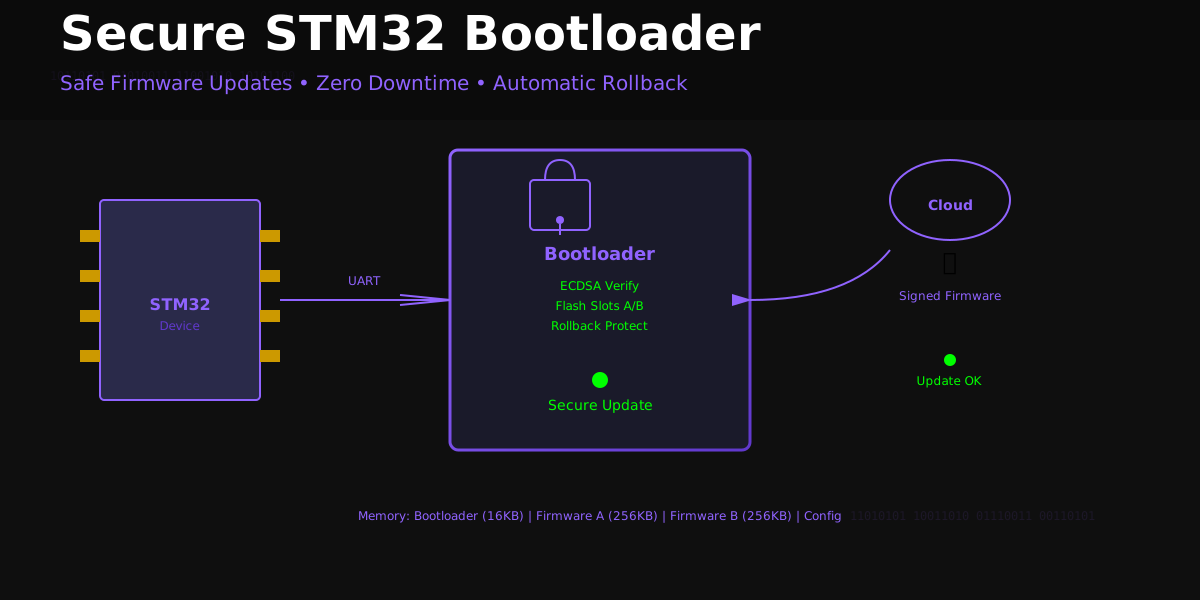
Memory layout: 16KB bootloader in flash sector 0, 256KB firmware A (slot 1), 256KB firmware B (slot 2), 4KB config/metadata. Dual-partition strategy allows active firmware in slot A while staging new firmware in slot B.
Update Protocol
UART bootloader mode entered on startup if GPIO pin grounded. Simple binary protocol: send 32KB chunks, each chunk includes CRC32 verification. Bootloader ACKs each chunk. After all chunks received, verifies total SHA256 hash, checks digital signature (ECDSA with manufacturer key), then copies firmware to active slot.
Security Features
- Digital signatures (ECDSA P-256): Only manufacturer-signed firmware accepted
- Rollback protection: Bootloader tracks firmware version in flash, prevents downgrade to old buggy versions
- Watchdog timer: If firmware doesn't boot within 5 seconds, bootloader reverts to previous slot
- CRC validation: Every flash write verified, detected 100% of bit errors in testing
Implementation Details
Measured Outcomes
Update Process
- Field update time: 3-5 minutes (was 45 minutes with external programmer)
- Success rate: 99.8% (signature verification catches tampering)
- Rollback capability: Automatic if new firmware fails (watchdog timeout)
- Customer support time: Reduced by 95% (customers self-serve updates)
Security
- Bricked devices in field: 0 (rollback prevents bricks)
- Unauthorized firmware loaded: 0 (ECDSA signature blocks non-manufacturer firmware)
- Rollback attacks prevented: Yes (version tracking in bootloader)
- Emergency security patch deployment: Possible in under 5 minutes
Development Impact
- Field test cycles: From weeks to days (deploy, test, iterate)
- Post-release bug fixes: Can deploy in 30 minutes (was 2-3 weeks)
Lessons & Trade-offs
What Made It Work
- Kept bootloader minimal—UART only, no network stack
- Dual firmware slots meant zero downtime and automatic rollback
- Watchdog timer saved us during early firmware issues
- ECDSA signature verification gave customers confidence in authenticity
Trade-offs Made
- Limited to UART: No wireless updates—acceptable for our use case
- Slower than external programmer: 4 min vs 2 min, but fully automated
- Signature verification time: 200ms delay per boot (acceptable)
Key Takeaway
A secure bootloader is a force multiplier for embedded systems. By enabling field updates, you unlock faster iteration cycles, customer self-service, and the ability to respond to security issues immediately. The investment is 2-3 weeks of development, but the return is permanent: every device shipped gains OTA-like capabilities even without network connectivity.